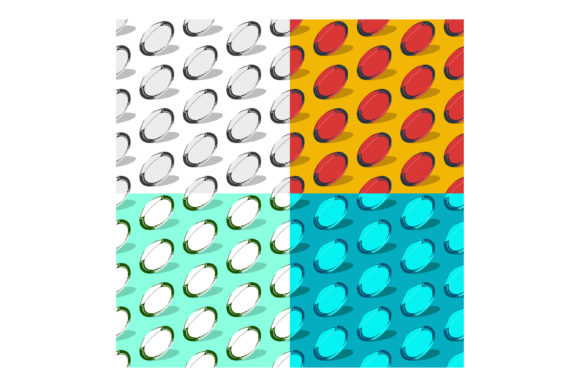
Patterns with Rugby Sport Ball. Team: Design Solutions for Cohesive Team Branding
When you are responsible for outfitting a rugby team, organizing a club event, or launching a sportswear line, one of the first challenges you face is creating a consistent visual identity. You need designs that look professional, feel energetic, and translate well across everything from jerseys to banners to fan merchandise. Patterns with Rugby Sport Ball. Team offers a practical, ready-to-use design resource that solves this exact problem. This collection of seamless vector patterns, built around rugby ball motifs and team sport aesthetics, gives you a foundation for building a unified brand without starting from scratch.
Whether you are a graphic designer, a team manager, or a small business owner producing custom apparel, understanding how to leverage these patterns effectively can save you hours of work and elevate the final result. This article explores what these patterns are, why they matter, and how you can apply them to real-world projects.
What Are Patterns with Rugby Sport Ball. Team?
At its core, Patterns with Rugby Sport Ball. Team is a curated set of seamless repeating patterns centred on the rugby ball as a primary design element. Seamless means the pattern tiles perfectly without visible edges, making it ideal for printing on fabric, wrapping paper, or digital backgrounds. The collection typically includes multiple variations: some patterns feature rugby balls arranged in geometric grids, others incorporate dynamic diagonal lines or clustered motifs that evoke movement and teamwork. Because these are vector files, you can scale them to any size without losing quality, whether you are printing a small patch or a large banner.
The "team" aspect of the name reflects the intended use — these patterns are designed to support team identity. They often come in colourways that can be customised, allowing you to match club colours or brand guidelines. Think of them as a toolkit: instead of designing a pattern from scratch, you select one that fits your energy and adapt it to your needs.
Common Challenges You Face with Team Apparel and Branding
Creating cohesive team branding is harder than it looks. One of the biggest obstacles is achieving consistency across different items. A jersey, a training top, a gym bag, and a social media graphic all need to feel like they belong to the same team, but each item has different shape, size, and material constraints. Without a unified pattern system, you end up with mismatched designs that look disjointed.
Another challenge is time. If you are a volunteer running a local club, or a designer juggling multiple clients, you do not have hours to spend repeating a motif by hand and testing whether it tiles correctly. You need a resource that is immediately usable.
Budget also plays a role. Commissioning a custom pattern from a textile designer can be expensive. For small teams or startups, that cost is often prohibitive. You need affordable, high-quality options that still look bespoke.
Finally, there is the challenge of versatility. What works on a polyester jersey might not look good on a cotton hoodie or a digital screen. A pattern that is too rigid or detailed can break when scaled or printed on a different substrate. You need something flexible.
How This Pattern Set Addresses Those Needs
Patterns with Rugby Sport Ball. Team directly tackles each of these issues. Because the patterns are seamless and vector-based, they scale perfectly. You can enlarge a pattern for a stadium banner or shrink it for a lapel pin, and it will remain crisp. This consistency means your brand stays intact across every item you produce.
The variety within the set gives you options without overwhelming you. You might choose a dense, tight repeat for a bold jersey print and a more spaced-out version for a subtle bag design. Having multiple patterns in one collection means you can mix and match to create a layered look while keeping the same core motif — the rugby ball — as the unifying element.
For those on a tight timeline, the patterns are plug-and-play. Open the file, select your colourway, apply it to your mockup, and you are ready to go. You eliminate the trial-and-error phase of creating a seamless tile. This alone can cut your design time by hours or even days.
Cost-effectiveness is another major benefit. A single set of vector patterns is a one-time purchase that you can use on unlimited projects. Compared to hiring a designer to create a custom pattern from scratch, the savings are significant. And because the files are editable, you can tweak colours or scale to fit your exact needs without starting over.
Practical Applications Across Different Use Cases
The true value of Patterns with Rugby Sport Ball. Team becomes clear when you look at how different users put it to work.
Apparel and Team Uniforms
This is the most obvious application. Seamless patterns work beautifully on performance fabrics used for rugby jerseys, shorts, and training tops. You can use a pattern as an all-over print on the main body of the jersey, or apply it to specific panels like sleeves or side inserts. For teams that want a modern, distinct look, an all-over pattern is a strong alternative to traditional striped or solid jerseys. The rugby ball motif reinforces the sport identity without being overly literal.
Fan Merchandise and Retail Products
Beyond uniforms, these patterns are ideal for fan gear. Think scarves, hats, tote bags, and hoodies. A subtle rugby ball pattern on a scarf or a repeating motif on a cap creates a collectible feel. Supporters want items that show allegiance, and a well-designed pattern adds a layer of sophistication beyond a simple logo. You can use the same pattern across multiple product types, creating a cohesive merchandise line that strengthens brand recognition.
Digital Assets and Social Media
Patterns are not just for fabric. You can use them as backgrounds for Instagram posts, website headers, or promotional videos. A seamless pattern gives your digital presence a professional, branded look. For a club announcing a new season, a background featuring rugby ball patterns in club colours immediately signals the sport and builds anticipation. Because the files are vector, you can export them at any resolution for web or print.
Event Materials and Club Stationery
If you are organising a tournament, award night, or fundraising event, consistent branding across tickets, banners, programmes, and signage makes a strong impression. Applying a rugby ball pattern to the edges of a programme or as a background on a banner ties everything together. It shows attention to detail and reinforces the team or event identity in a subtle, memorable way.
Interior and Team Spaces
Clubhouses, changing rooms, and team buses can also benefit. Printed curtains, cushion covers, or wall decals using the pattern create an immersive team environment. For schools and universities with rugby programmes, this kind of interior branding fosters pride and a sense of belonging.
Recommendations for Getting the Best Results
To make the most of Patterns with Rugby Sport Ball. Team, approach it with a clear strategy. Start by defining your colour palette. Most vector pattern sets are fully colour-editable, so take advantage of that. Choose two or three core colours that represent your team or brand. Avoid using too many colours in one pattern; a limited palette keeps the design cohesive and easier to reproduce across different printing methods.
Consider scale carefully. A pattern that looks great on screen at 100% might feel too busy on a jersey or too sparse on a large banner. Test the pattern at different sizes within your design software before committing. A good rule of thumb is to use smaller repeats for small items and larger repeats for big surfaces.
Layer patterns with solid elements. A full all-over print can be striking, but sometimes a pattern works better as an accent. Try using it on a single sleeve panel, the back of a jersey, or as a stripe down the side of shorts. Combining the pattern with solid colour areas creates visual interest without overwhelming the viewer.
For teams that want to stand out, consider using a pattern in a tonal or monochrome version. For example, a light grey rugby ball on a white background, or a navy motif on a slightly lighter navy ground. These subtle treatments look premium and work well for coaching staff or formal team apparel.
How Different Users Approach the Topic
Graphic designers tend to use Patterns with Rugby Sport Ball. Team as a starting point. They open the file, adjust colours to match the client's brand guidelines, and then integrate the pattern into a larger design system. They appreciate the vector format because it gives them complete control over scaling and editing. For them, the pattern is a building block, not the final product.
Team managers and club volunteers often take a more direct approach. They want to upload the pattern to a print-on-demand platform or send it directly to a uniform supplier. Their priority is ease of use and clear instructions. They benefit from sets that come with multiple pre-coloured versions so they can simply pick one that matches their existing kit.
Sportswear brand owners and entrepreneurs look at the patterns from a product development angle. They consider how the pattern will look across a full collection — training wear, match day kit, casual apparel, and accessories. They value versatility and often purchase multiple pattern sets to mix and create a unique brand language.
DIY enthusiasts and school club coordinators might use the patterns for smaller projects like decorating team banners, making personalised water bottles, or creating gift wrap for end-of-season awards. For them, the seamless nature of the pattern makes it easy to print at home or at a local print shop without worrying about alignment issues.
Outcomes You Can Expect
When you use a resource like Patterns with Rugby Sport Ball. Team thoughtfully, the outcomes are tangible. First, your team or brand gains a professional, cohesive look that sets you apart from generic "off-the-shelf" designs. People notice consistency. It signals that you care about details and that your organisation is well-run.
Second, you save time and reduce stress. Instead of wrestling with pattern creation, you focus on the creative decisions that matter — colour, scale, placement, and integration. The technical groundwork is done for you.
Third, you build a visual language that extends across every touchpoint. From the jersey a player wears to the banner behind the post-match interview, the pattern ties it all together. Over time, that repetition builds brand recognition. Fans and opponents alike come to associate that specific pattern with your team.
Finally, you gain flexibility. Because the patterns are vector and seamless, you can keep using them season after season, adapting colours or scales as your brand evolves. It is a long-term investment in your visual identity.
Final Considerations for Implementation
Before you start, check the file format and compatibility with your design software. Most vector pattern sets come in Adobe Illustrator (AI), EPS, or SVG formats. If you are not a designer, consider asking a local print shop or freelancer to help with colour adjustments and output. Many print-on-demand services accept vector files directly, so you can upload and order samples with minimal hassle.
Think about sustainability if you are printing on fabric. Choose a print method that works well with repeating patterns — sublimation printing is excellent for polyester apparel, while screen printing may require you to register the repeat carefully. Talk to your supplier about the best approach for your chosen pattern and fabric type.
Lastly, do not be afraid to customise. The best results come when you adapt the pattern to your unique context. Change colours, combine elements from different patterns in the set, or superimpose your team logo over the design. The pattern is a foundation, not a cage.
Patterns with Rugby Sport Ball. Team is more than a decorative element. It is a practical tool for building a strong, recognisable team identity across apparel, merchandise, digital media, and physical spaces. When used with intention, it transforms a simple motif into a unifying brand language that connects players, fans, and the wider community. Whether you are designing for a professional club or a local youth team, this resource gives you a professional starting point that saves time, reduces cost, and delivers consistent, high-quality results.